


Views: 0 Author: Site Editor Publish Time: 2026-08-12 Origin: Site


Medical device manufacturing presents a relentless challenge for engineering teams globally. You must constantly balance stringent ISO and FDA compliance against scalable production economics. Every secondary assembly step you add introduces variables you simply cannot afford. Adhesives can fail under stress. Ultrasonic welds often present micro-cracks. Manual handling intrinsically introduces unwanted bio-burden into sterile environments.
Enter multi-shot processing. We view this process not just as a manufacturing technique, but as a robust risk-mitigation strategy. It permanently eliminates secondary assembly operations from your workflow. It drastically reduces dangerous biological contamination vectors. It also fundamentally improves overall part precision by maintaining geometric alignment within the mold.
This article delivers a comprehensive technical and commercial framework. You will learn exactly when the heavy capital expenditure of multi-material tooling makes sense. We explore critical design triggers, advanced material combinations, and strict implementation realities. This knowledge helps you optimize production strategies for your next-generation clinical devices.
Assembly Elimination: 2K molding replaces manual or automated secondary assembly, directly reducing bio-burden risks and labor costs.
Superior Adhesion: Chemical bonding between rigid and soft substrates (e.g., PC and TPU) offers higher reliability than adhesives or snap-fits.
Volume Thresholds: The high initial tooling cost of double shot molding requires a specific production volume breakeven point to justify ROI compared to traditional overmolding.
Compliance Integration: Single-cycle production inside a cleanroom environment simplifies validation and traceability.
Secondary assembly of medical devices constantly introduces hidden risk factors. Combining separate plastic parts creates inevitable tolerance stacking issues. A minor variance in two mating components can compromise device functionality. These physical joints often become structural weak points over time. More importantly, every manual or robotic handling step increases the risk of biological contamination. You must rigorously validate every adhesive, snap-fit, or ultrasonic weld used in the assembly process.
Producing a multi-material part in a single machine cycle solves this fundamental issue. We see massive risk reduction when handling between manufacturing steps disappears. Both substrates remain perfectly aligned within the steel mold cavity. This integrated approach ensures consistent dimensional accuracy across thousands of continuous production cycles.
Success criteria focus heavily on operational efficiency and defect elimination. You can expect significantly reduced scrap rates from human assembly errors. High production volumes inevitably yield a much lower per-unit cost. Furthermore, integrating medical plastic parts simplifies your supply chain. You rely on one supplier, use one complex tool, and manage one streamlined validation process.
Breakeven analysis requires weighing higher upfront capital expenditures against operational savings. Multi-shot molds cost substantially more than standard single-shot tools due to their complexity. However, they deliver immense long-term unit cost savings by removing secondary labor operations entirely. You reach the breakeven point when the accumulated labor savings surpass the initial tooling premium. High-volume clinical runs easily justify this upfront financial investment.
Certain device designs make secondary assembly practically impossible or highly unsafe. When devices require permanent, leak-proof IP-rated seals, loose O-rings fail to provide reliability. Surgical fluid management systems and drug delivery devices demand perfectly integrated seals and gaskets. Molding the elastomer directly onto the rigid housing guarantees a flawless, permanent fluid barrier. This prevents dangerous fluid ingress or egress during critical medical procedures.
Surgical instruments often require ergonomic grips for physician comfort. Clinical conditions demand precise tactile feedback and reliable slip resistance, especially when wet. In these exact scenarios, incorporating soft-touch medical components becomes an absolute necessity. The process bonds elastomers directly to rigid instrument handles without utilizing messy adhesives. This prevents the grip from peeling, twisting, or degrading during rigorous surgical operations.
Portable medical monitors house highly sensitive internal electronics and intricate fluid pathways. Dropping these portable devices can cause catastrophic operational failure in fast-paced clinical settings. Integrating vibration and impact dampening features directly into the device chassis protects these critical internals. A molded-in elastomeric bumper absorbs mechanical shock far better than a glued-on alternative.
Visual indicators play a vital role in clinical usability and safety protocols. Utilizing two-color injection molding allows manufacturers to embed distinct colors permanently within a single part. You can easily create color-coded surgical tool handles for instant identification in the operating room. This technique supports corporate branding and strict regulatory compliance without using external paints. Paints can chip easily over time, creating severe particulate contamination hazards in sterile environments.
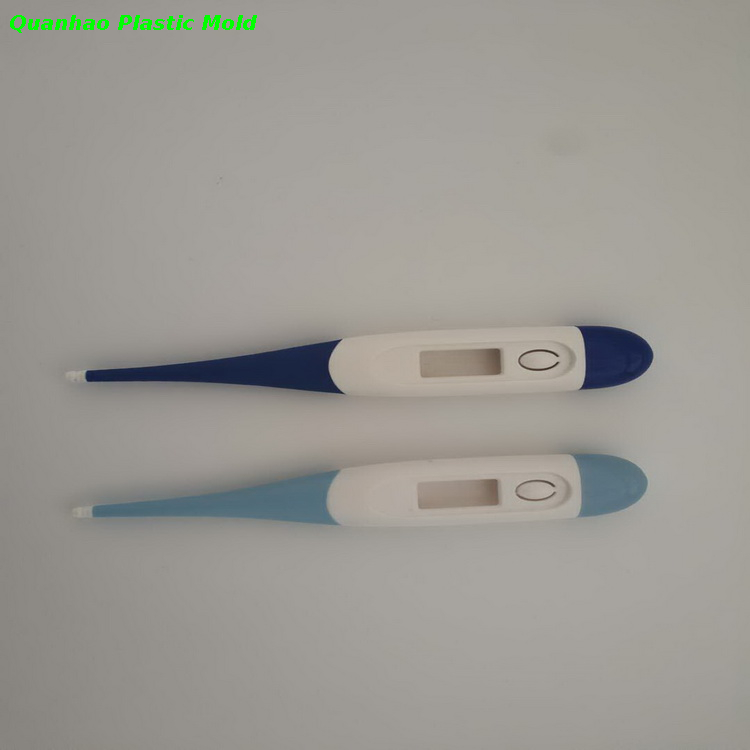
Effective material pairings dictate long-term part integrity and clinical performance. We must clearly distinguish between basic mechanical interlocking and true chemical bonding. Mechanical interlocking uses physical undercuts, holes, or dovetails to hold the second material firmly in place. Chemical bonding relies entirely on molecular adhesion between the two distinct polymers. Superior device designs leverage both methods simultaneously, but true molecular adhesion provides the strongest permanent interface.
Evaluating substrate pairs requires careful chemical compatibility checks. Hard-and-soft combinations represent the most common medical applications. Engineers frequently pair rigid Polycarbonate (PC) or robust ABS with flexible elastomers during TPU TPE overmolding. We also see hard-and-hard combinations in advanced diagnostic devices. You might combine distinct rigid polymers to balance high structural strength against aggressive chemical resistance requirements.
Medical devices demand strict biocompatibility verification before entering the market. Both selected materials must independently pass rigorous ISO 10993 requirements. This applies heavily to skin contact duration or direct fluid path exposure scenarios. You must also verify that the high-heat manufacturing process does not alter the underlying chemical properties of either selected resin.
Sterilization compatibility presents another massive engineering hurdle for design teams. Different materials react uniquely to extreme cleaning environments. You must select polymer pairings that degrade at the exact same rate. Whether exposed to Autoclave heat, Gamma radiation, or EtO gas, both polymers must maintain their mechanical properties without delaminating over the device's intended clinical lifespan.
Engineers must eventually choose between standard pick-and-place methods and fully integrated multi-shot systems. Understanding the technical boundaries of each approach helps optimize your manufacturing scale.
This traditional approach involves molding a rigid substrate first in a standard machine. An operator or a robotic arm then transfers it into a completely separate second mold cavity. The machine then injects the soft elastomer over the rigid part.
It works best for low-to-medium production volumes where automation isn't critical. We often recommend it for early-stage prototyping phases and clinical trials. It also suits projects where capital budgets remain highly restricted and cannot support complex rotating tooling.
However, the technical limitations remain highly significant. The process requires manual or robotic transfer of the first shot. This interim handling introduces a much higher risk of particulate and biological contamination. The rigid substrate also cools completely before the second shot occurs, which actively weakens the resulting chemical bond. Overall cycle times run considerably longer.
A highly automated system injects two distinct materials within a single, continuous molding cycle. Specialized machinery featuring multiple injection barrels manages the entire process internally.
This method is best for high-volume production runs demanding extreme consistency. It easily handles tight micro-molding tolerances needed for invasive surgical tools. We specifically mandate it for life-critical devices with strict zero-defect requirements.
The manufacturing advantages far outweigh the initial tooling complexity. The rigid substrate remains trapped safely inside the same machine, often on a precision rotating platen. It retains vital latent heat from the initial polymer injection. This residual heat promotes superior molecular chemical bonding. It also guarantees perfect dimensional stability because the part never leaves the initial clamping environment until fully completed.
Feature |
Standard Overmolding |
Integrated Multi-Shot Processing |
|---|---|---|
Ideal Production Volume |
Low to Medium scale |
High to Very High scale |
Upfront Tooling Cost |
Lower (Requires two simpler molds) |
Higher (Requires one highly complex mold) |
Contamination Risk Level |
Moderate (External handling required) |
Very Low (Single-cycle enclosed environment) |
Polymer Bond Strength |
Good (Relies heavily on mechanical locks) |
Excellent (Leverages high chemical adhesion) |
Dimensional Tolerance |
Moderate (Prone to transfer variations) |
Exceptional (Zero transfer handling) |
Moving from a digital CAD model to commercial reality demands rigorous upfront planning. You must acknowledge that multi-shot molds are highly complex mechanical instruments. They require exact steel shut-offs to prevent unwanted flashing between the two material boundaries. You should expect notably longer tool design phases and extended precision machining timelines before production begins.
Validation protocols like IQ, OQ, and PQ govern the entire medical manufacturing space. These processes directly impact FDA submissions and ISO 13485 validation efforts. Proving process stability for dual-barrel systems is undoubtedly more complex than single-shot setups. However, you only need to perform this stringent validation for one integrated system. This easily beats validating two entirely separate assembly lines and their associated handling procedures.
Controlled cleanroom environments are non-negotiable for most invasive or fluid-path devices. You must ensure your manufacturing partner operates specialized multi-barrel injection machines. These systems must sit entirely within certified ISO Class 7 or Class 8 cleanrooms. This pristine environment prevents airborne particulate contamination during the critical molding cycle.
Shortlisting a highly qualified manufacturing partner requires specific, evidence-based evaluation criteria. You should look for operations that specialize heavily in 2K injection molding medical plastic components.
Consider these crucial evaluation factors during your supplier audits:
In-house mold making capabilities to handle complex maintenance and rapid tooling adjustments.
A proven, specific medical portfolio demonstrating deep multi-shot technical expertise.
Advanced metrology capabilities, such as CT scanning, for validating tight internal tolerances.
Deep material science knowledge regarding biocompatible polymer adhesion and degradation.
Implementing integrated multi-material molding is a high-stakes, high-reward engineering strategy. It demands rigorous upfront design efforts and highly specialized automated machinery. However, it yields unmatched component integrity and eliminates dangerous secondary contamination vectors. Transitioning away from risky manual assembly operations fundamentally improves patient safety and production scalability.
Engineering teams should immediately initiate a Design for Manufacturability (DFM) review. We strongly advise engaging a specialized molding partner to conduct comprehensive mold-flow analysis before freezing your device CAD models. Early stage collaboration guarantees your chosen polymers will bond correctly and perform flawlessly in real-world clinical environments.
A: High-volume medical production strictly requires Class 101 mold standards. Engineers design these robust tools to exceed one million continuous cycles. Toolmakers utilize premium hardened stainless steel to withstand highly abrasive medical-grade resins. Proper preventative maintenance within a controlled cleanroom environment ensures these precision molds maintain exact material shut-offs and deliver consistent part quality for years.
A: True single-cycle multi-shot molding is extremely difficult to prototype accurately without cutting expensive steel. As a functional bridge, we suggest using standard pick-and-place overmolding for initial testing. Alternatively, advanced multi-material 3D printing can successfully validate ergonomics and part geometry. However, recognize that these alternative methods will never perfectly replicate the chemical bond strength of final production tooling.
A: Combining two distinct resins introduces highly complex cooling dynamics. Each injected material possesses unique thermal properties and specific volumetric shrink rates. As they cool simultaneously inside the mold, unequal shrinkage can cause severe part warping. Extensive mold-flow simulation analysis is absolutely necessary to predict these complex interactions. Engineers must optimize gate locations and internal cooling channels to ensure dimensional stability.


