


Views: 0 Author: Site Editor Publish Time: 2026-07-02 Origin: Site


Sourcing interior components is no longer just about aesthetics. It is a critical balancing act between lightweighting, strict safety compliance, and unit economics. For procurement teams and automotive engineers, evaluating manufacturing partners requires looking past surface-level quotes. You must assess tooling reliability. You need to verify material science expertise. You also need to examine their quality control systems. A poor choice leads to costly production delays and compromised cabin safety.
This guide breaks down the technical and commercial criteria for evaluating suppliers. We will show you how to effectively assess manufacturers of automotive plastic parts. You will learn actionable strategies to ensure successful, risk-free production rollouts for your upcoming vehicle programs.
Material selection dictates both structural integrity and regulatory compliance (e.g., VOC emission limits for interiors).
Evaluating a supplier's injection molding capabilities requires scrutinizing their tooling maintenance, multi-shot capabilities, and defect-rate history.
Reliable procurement hinges on strict adherence to IATF 16949 standards and rigorous PPAP (Production Part Approval Process) execution.
Modern automotive engineering demands constant innovation. We constantly push to reduce vehicle weight. Lighter vehicles improve overall fuel efficiency. They also extend the crucial driving range of electric vehicles (EVs). However, you cannot compromise NVH (Noise, Vibration, and Harshness) performance. High-quality car plastic parts must actively absorb road noise. They must dampen engine and wind vibrations. Thin-walled designs save weight but often increase cabin noise. You need a supplier who understands advanced acoustic dampening techniques.
Cabin environments also demand flawless haptics. Consumers touch these surfaces daily. They expect premium textures. High-quality Class-A surfaces are non-negotiable for modern drivers. Your supplier must deliver consistent graining across complex geometries. UV degradation resistance is another massive hurdle. Severe sun exposure breaks down inferior polymers quickly. It causes fading, cracking, and chalking. Proper resin selection prevents these visual failures.
Furthermore, you must navigate intense regulatory frameworks. Passenger safety relies on strict compliance. FMVSS (Federal Motor Vehicle Safety Standards) dictate rigorous crash safety protocols. Interior components must pass severe flammability tests. Beyond physical crashes, air quality matters immensely. OEMs enforce strict cabin outgassing limits. High VOC (Volatile Organic Compound) emissions cause the famous "new car smell," but they pose actual health risks. You must select materials and processes emitting near-zero VOCs.
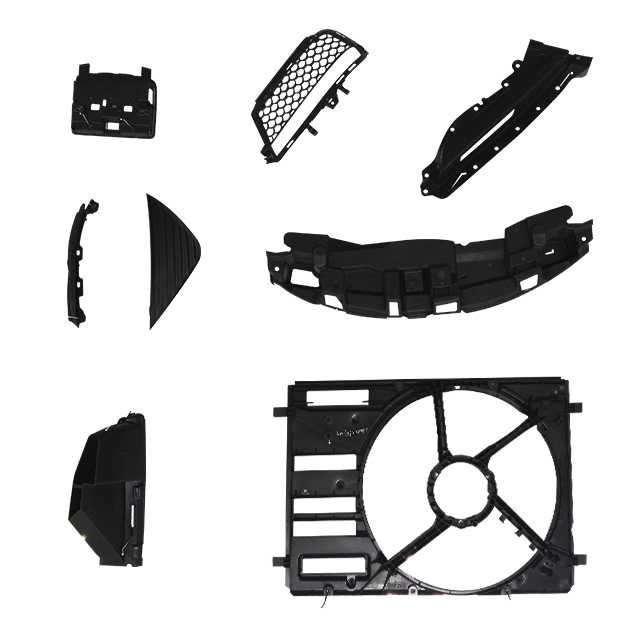
Plastics are not created equal. You must match the polymer to its specific functional requirement. Choosing the wrong resin leads to catastrophic part failures. It also destroys your expected profit margins.
Commodity resins offer excellent value. Polypropylene (PP) and Thermoplastic Olefins (TPO) remain incredibly popular in the automotive sector. They are highly cost-effective. They resist aggressive automotive chemicals. You will typically use PP and TPO for lower door panels. They also work perfectly for hidden structural brackets and pillar covers.
Engineering resins handle tougher environments. ABS and PC/ABS blends provide massive structural benefits. They offer high impact resistance. Their dimensional stability prevents warping under extreme greenhouse cabin heat. You should standardly specify PC/ABS for instrument panels. Center consoles and structural trim also require these robust blends to survive daily abuse.
Sustainability now drives major automotive decisions. OEMs actively seek greener alternatives. We must assess post-consumer recycled (PCR) plastics carefully. Biopolymers offer a noticeably lower carbon footprint. However, you cannot blindly swap virgin resins for PCR. You must verify tensile strength remains intact. You must also ensure aesthetic consistency across large, multi-year production batches.
Material choices directly impact production dynamics. Specific resins alter shrinkage rates. They change expected cycle times. High-shrinkage materials increase the likelihood of warp. They also cause ugly sink marks on Class-A surfaces. Your engineering team must validate material-to-process compatibility early in the design phase.
Material Type |
Key Characteristics |
Typical Automotive Applications |
Relative Cost |
|---|---|---|---|
Polypropylene (PP) |
Chemical resistant, lightweight, highly flexible |
Lower door trims, hidden brackets, pillar covers |
Low |
TPO |
Excellent weatherability, low thermal expansion |
Dashboard skins, airbag covers, soft-touch areas |
Medium |
ABS |
Rigid, highly paintable, excellent surface finish |
Air vents, switch bezels, decorative trim |
Medium |
PC/ABS |
High impact strength, superior heat resistance |
Center consoles, instrument panels, structural frames |
High |
Manufacturing complex interiors requires advanced technological capabilities. You cannot rely on basic molding techniques. You need suppliers proficient in multi-shot molding. 2K and 3K molding processes create seamlessly integrated soft-touch surfaces. Overmolding bonds multiple materials into a single solid part. This eliminates secondary manual assembly steps. It reduces factory labor costs. It also eliminates the annoying squeaks and rattles caused by clipped assemblies. Reliable automotive injection molding demands these advanced techniques.
Tooling architecture dictates your entire production run. The physical automotive plastic mold represents your largest upfront investment. You must evaluate the supplier's tooling strategy deeply. Do not cut corners here.
Consider the mold steel grade carefully. P20 steel works well for moderate volumes. It machines easily and costs less upfront. H13 steel provides superior hardness. You need H13 for high-volume runs using abrasive glass-filled resins. Next, review their cooling channel designs. Conformal cooling channels hug the part's complex geometry. They remove heat rapidly. Better cooling optimizes your cycle times. You must also agree on a cavitation strategy. Single-cavity molds offer maximum precision. Multi-cavity molds increase output but require much tighter process controls.
Tolerance and precision separate average suppliers from elite manufacturing partners. High-volume runs experience natural variations. Your supplier must maintain tight geometric dimensioning and tolerancing (GD&T). Validate their ability to measure and correct deviations quickly. Perfect repeatability is mandatory for custom automotive components. Assembly lines halt completely if retaining clips do not align perfectly.
Trust requires strict verification. In the automotive sector, quality control failures cost millions in recalls. Industry certifications provide your first layer of defense. IATF 16949 certification is the non-negotiable baseline. It proves the manufacturer utilizes a standardized, automotive-specific quality management system. You should never evaluate a manufacturer of OEM auto parts lacking this exact certification.
The Production Part Approval Process (PPAP) guarantees consistency. A robust PPAP framework prevents unpleasant surprises during full production. Suppliers must execute several critical steps flawlessly:
Design Records: Thorough documentation of all part schematics and material specs.
FMEA Execution: Comprehensive Failure Mode and Effects Analysis to predict and prevent future defects.
Control Plans: Strict procedures mapping out how machine operators will monitor the injection process.
First Article Inspection (FAI): Deep metrological verification of the very first parts off the tool.
Part Submission Warrant (PSW): Final sign-off confirming the parts meet all OEM requirements perfectly.
Traceability and testing capabilities complete the quality picture. Evaluate the supplier's in-house metrology labs. They must own modern Coordinate Measuring Machines (CMM). They should utilize 3D scanning for complex organic shapes. Furthermore, check their environmental testing setups. Interior parts face extreme conditions. They bake in aggressive summer heat. They freeze in brutal winter snow. Suppliers must run extensive thermal cycling tests. Impact testing ensures the plastic will not shatter into dangerous shards during cold-weather collisions.
Finding a capable supplier is only half the battle. You must ensure their business model seamlessly aligns with yours. Capacity and scalability act as major filtering criteria. You need to match their machine tonnage to your specific component sizes. A 50T injection molding machine handles small retaining clips perfectly. Conversely, a massive 3000T+ machine is absolutely necessary for molding entire dashboard fascias. Verify they have the right equipment for your long-term volume forecasts.
Tooling ownership often causes nasty legal disputes. You must clarify contract terms immediately. Who officially owns the mold once production begins? Usually, the OEM pays for the tool and retains full ownership. You must also assign preventative maintenance responsibilities. Molds require regular cleaning and greasing. Define who pays for end-of-life replacement costs when the tool finally degrades past tolerance limits.
Supply chain resilience prevents sudden assembly line shutdowns. Look closely at your supplier's geographic footprint. Localized suppliers drastically reduce shipping delays. Assess their raw material sourcing redundancies. If one resin plant shuts down unexpectedly, can they source from another? Also, evaluate their secondary operation capabilities. A supplier offering in-house painting, sonic welding, and final assembly saves you massive logistical headaches.
Structuring an effective Request for Quote (RFQ) is your final vetting step. Do not accept vague blanket pricing. Demand extreme transparency from day one.
Ask for detailed tooling amortizations.
Require clear scrap rate assumptions.
Request labor cost breakdowns for secondary operations.
Verify packaging and logistics fees upfront.
Selecting a manufacturing partner for interior components requires a holistic evaluation. You cannot base your decision purely on the lowest piece price. You must analyze their engineering support. You must audit their quality frameworks. You must also heavily inspect their tooling infrastructure.
Prioritize suppliers who act as early-stage engineering consultants. Design for Manufacturability (DFM) expertise is crucial. Good partners spot draft angle issues before cutting steel. They suggest better gating locations to hide ugly blemishes. Mere build-to-print vendors follow your flaws blindly. Consulting partners minimize downstream production risks and drastically improve your final product.
Do not leave your next vehicle program to chance. Prompt your procurement team to download a supplier evaluation checklist today. Request a comprehensive material consultation. Submit your detailed RFQ and start building a resilient automotive supply chain.
A: Polypropylene (PP) and PC/ABS dominate automotive interiors. PP offers an unbeatable cost-to-performance ratio. It resists chemicals and handles high flexing well. PC/ABS blends provide superior impact resistance and dimensional stability. Engineers heavily utilize PC/ABS for rigid structures like instrument panels and center consoles.
A: Higher upfront investment in premium mold steel reduces cycle times significantly. Excellent cooling channels allow parts to solidify faster. High-quality molds also minimize flash, which eliminates costly manual rework. Furthermore, premium steel extends the tool's usable life. This drastically improves long-term production economics and part consistency.
A: OEM parts demand rigorous compliance. Suppliers must strictly adhere to the PPAP framework. They must provide complete material lot traceability. Furthermore, OEM assembly line integration dictates much tighter geometric tolerances. Aftermarket parts often skip these expensive validation steps, resulting in inconsistent fitment and unpredictable material longevity.
A: Manufacturers prevent outgassing through careful resin selection. They utilize specific compounding processes designed to trap volatile organics. Post-molding baking and venting procedures further eliminate trapped gases. These rigorous steps ensure the interior plastics meet strict OEM air quality standards and eliminate the toxic "new car smell."


